
By REMEMBER
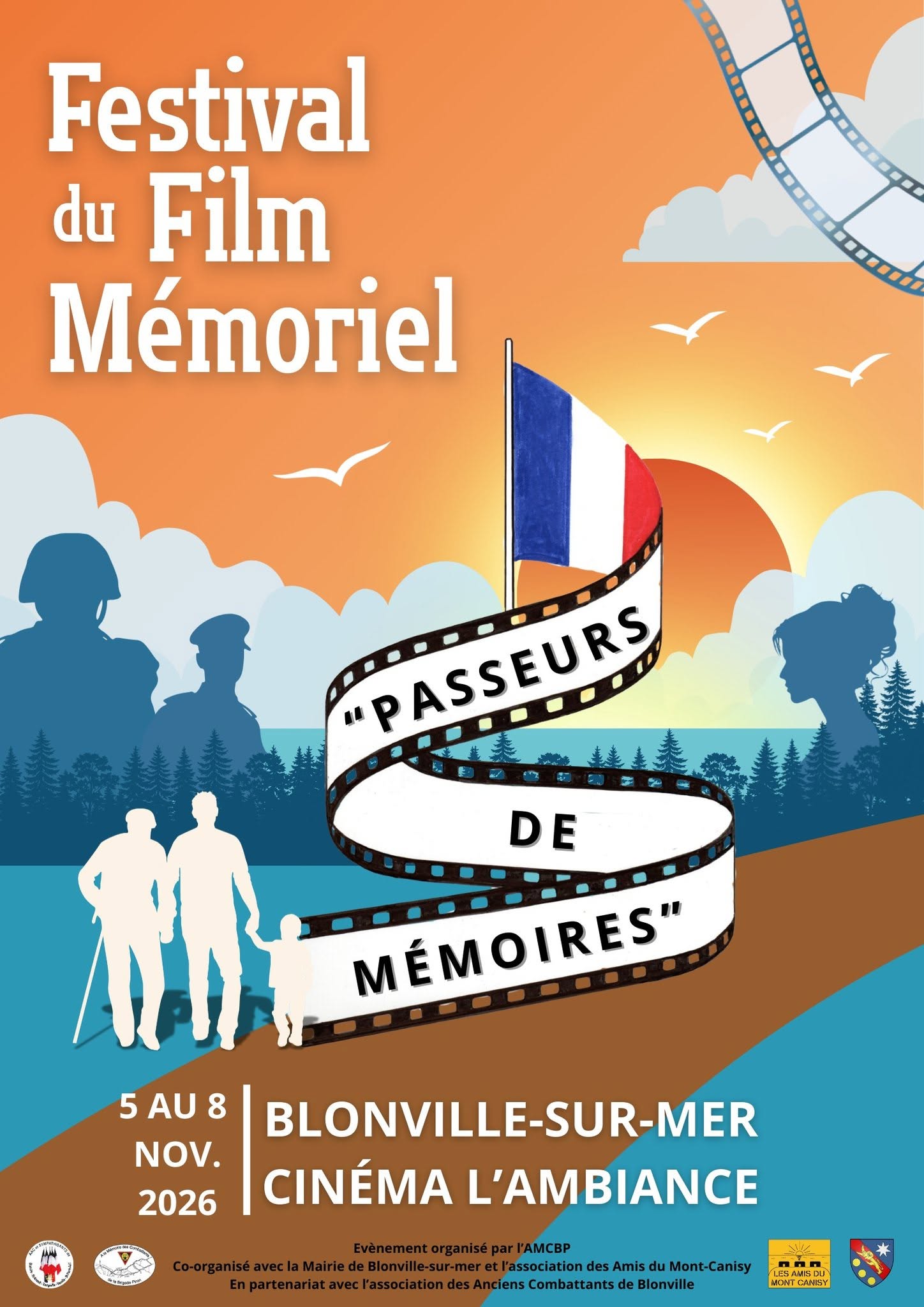
From 5 to 8 November 2026, the small seaside town of Blonville-sur-Mer, on the Normandy coast, became a place where history was watched, discussed and handed on. The first Festival du Film Mémoriel brought documentaries, short films and conversations to Cinéma l’Ambiance, on the ground floor of the town hall. REMEMBER was proud to take part, and we want to share what the four days were about.
Why a festival of memory films?
The festival was organised by the AMCBP, in association with the Mairie de Blonville-sur-Mer and the Amis du Mont-Canisy, and in partnership with the Association des Anciens Combattants de Blonville. Its idea was simple and ambitious: to use film as a way of passing memory on, and then to give audiences the chance to talk with the people who made the films.
Almost every screening ended with an exchange with the public, and Stéphane Encel, the festival’s “parrain“, co-hosted these discussions throughout the four days. All screenings were free, and donations were welcomed to help make similar projects possible.
Thursday 5 November: why transmit the past at all?
The festival opened with a conference by Stéphane Encel, Histoire et transmission au XXIᵉ siècle. His starting point was a striking question: in a century of such deep upheaval, can we still be sure that the past matters, and that we are able to pass it on? His answer was that knowledge of history and the transmission of memory may be among the keys to humanity’s survival. The conference set the tone for everything that followed. That evening, an invitation-only screening of Vincent Pouchain’s La Brigade Piron : le pont de l’Union took place.
Friday 6 November: hidden children and enemies who met again
Friday afternoon began with Arnaud Blin’s documentary 1944 : les colis sont bien arrivés. In March 1944, two Jewish brothers, Arthur and Adrien Ostier, aged 8 and 6, were sent by their parents to hide in Normandy, at the congregation of the Vierge Fidèle in Douvres-la-Délivrande. They found each other again during the Landings. Through their family story, the film uncovers a little-known episode in the persecution of Jews in Normandy during the Second World War. Arnaud Blin joined the audience for the discussion.
In the early evening came Destins croisés, directed by Rodolphe Rutman. Kenneth, an American, and Franz, a German, both received their baptism of fire on Omaha Beach on 6 June 1944. Sixty years later, each returns to the places where he prepared for war in 1943-44, and then, for the first time, the two former enemies meet on the ground where they once faced each other. Archive films and the memories of American, British, German and French civilians complete the picture of a painful and complex era.
The day closed with Jérémy Rozen’s J’ai deux amours, which follows Josephine Baker, the first international Black star, and the generation of Black American artists who crossed the Atlantic and settled in France in the 1920s and 1930s. It is a story between two shores, two wars and two cultures. Jérémy Rozen was present to talk with the audience.
Saturday 7 November: testimony, a lost chalice and a river
Saturday afternoon was devoted to Les Immortels, a series of short films by Olivier Nakache and Éric Toledano, made at the initiative of the Mémorial de la Shoah. Each film brings a young person face to face with one of the last survivors of the Shoah, in a human-scale encounter that carries a personal story of persecution, deportation and survival. This screening featured the testimonies of Léon, Ginette and Judith, and was recommended for ages 14 and over. Flavie Bitan was there for the discussion.
In the late afternoon, Alain Monclin presented Un calice dans la tourmente. A chalice found in a Moroccan souk in 2019, after some 80 years of wandering, leads him to the trail of a priest who was part of the Resistance. Piece by piece, the film reconstructs the object’s story and that of the man who owned it. Alain Monclin and Christine Le Callonec took questions afterwards.
The evening belonged to Un fleuve pour la liberté, la Dives, made by Alain Monclin with the association Un fleuve pour la liberté. It revisits the Second World War in the coastal area between the Orne and the Dives, including the Sword Beach landing zone, through the accounts of local residents, archives, historians and images of the places as they look today. It retraces the fighting, the Resistance and the daily experience of the local population. Christine Le Callonec joined the audience for the discussion.
Sunday 8 November: the Big Red One on Omaha Beach
Sunday afternoon was a moment of particular importance for us. Big Red Omaha, by Jacques and Rodolphe Rutman, tells the story of the D-Day landing on Omaha Beach through the testimonies of American veterans of the 1st Infantry Division, the “Big Red One”. Some of them describe the fighting they lived through, while others come back to Normandy decades later, sometimes for the first time, to the places where that decisive day unfolded. Rodolphe Rutman was there to answer the audience’s questions.
The festival ended with a second screening of Les Immortels, this time with the testimonies of Léon, Larissa and Yvette, and again with Flavie Bitan.
What we take away
What stays with us from these four days is how much the films and the conversations around them complemented each other. A veteran’s account on Omaha Beach, a child hidden in a convent, a chalice found in a market, a young person listening to a survivor: each story is different, but together they remind us that memory is not only about the past. It is something we keep alive by listening, asking questions and passing it on.
Thank you
Our sincere thanks go to the AMCBP for organising the festival; to the Mairie de Blonville-sur-Mer, the Amis du Mont-Canisy and the Association des Anciens Combattants de Blonville for their support; to Stéphane Encel for his role as godfather and co-host; to all the filmmakers and guests who came to speak with the public; and, above all, to everyone who came to watch, listen and remember.
To find out more about REMEMBER and our work, follow us here. For information about the festival, contact the AMCBP at amcbp14@gmail.com.